Meaningless Exhaustion: How a Society Falls into Consumptive Competition
On this land, at once familiar and alien, people have long since learned how to run—yet forgotten why they ever started.
College entrance exams, job hunts, endless overtime, a flood of certificates and qualifications… these are the daily rhythms of our lives, collectively known as “involution.” On the surface, they seem to measure competence, but in truth, they drain individual energy. More cruelly, they consume not only time and physical strength, but also one’s passion for life and impulse to create.
The term “consumptive competition” is neither elegant nor noble. It lacks the halo of “striving” and “ambition,” and instead sounds dim, even bleak. It doesn’t describe the opening of upward mobility, but the spread of survival anxiety; not a necessary path to an ideal society, but a systemic trap into which we’ve collectively fallen.
This form of competition is the maintenance of an illusion. Like someone standing up in a movie theater to see better—forcing those behind to stand too—eventually everyone is standing, yet no one sees any farther. The unequal distribution of resources and the scarcity of upward paths compel individuals to prove themselves “worthy of selection” through increasingly intense, formalized competition. But this process of proof creates no new value. It only repeats, mimics, dissipates—grinding down people’s potential and willpower, round after round.
This isn’t the fault of individuals. No one is born loving involution, just as no one longs to be trapped on a treadmill. The problem lies in a system obsessed with metrics, fixated on quantifiable performance, and addicted to “stable outcomes.” Thus, education becomes a testing machine, work becomes a pile of assessments, time is filled to the brim—while the soul is gradually hollowed out.
Some say this is a helpless choice, the inevitable road of the times. But is it really? True creation and progress have never come from uniform conformity, but from those willing to explore possibilities amid chaos. Yet these are the very people most easily eliminated in today’s social climate. Because they do not follow the “standard process,” they lack quantifiable achievements and are thus deemed “unqualified” by the system.
Our whole society resembles a machine running on faulty instructions—spinning rapidly, but going nowhere. We’re exhausted, dragged along by one another, yet powerless to stop. If you don’t join the race, you fall behind. If you try to step away, you find yourself surrounded by walls—engraved with words like “reality,” “responsibility,” and “survival.”
This is not just a systemic trap—it’s the collapse of collective will. We no longer believe that real value comes from creation and collaboration. Instead, we’ve come to accept that all effort must manifest through competition. Everything can be replaced, except one thing: your willingness to endure more, to grind harder—even if that very will is slowly destroying you.
And if there is tragedy in this, it’s that even after recognizing its meaninglessness, we still have no choice but to continue.
Have you ever heard the subway at 2 a.m.?
It doesn’t belong to dreams, nor to passion.
It belongs only to those who dare not stop.
Picture
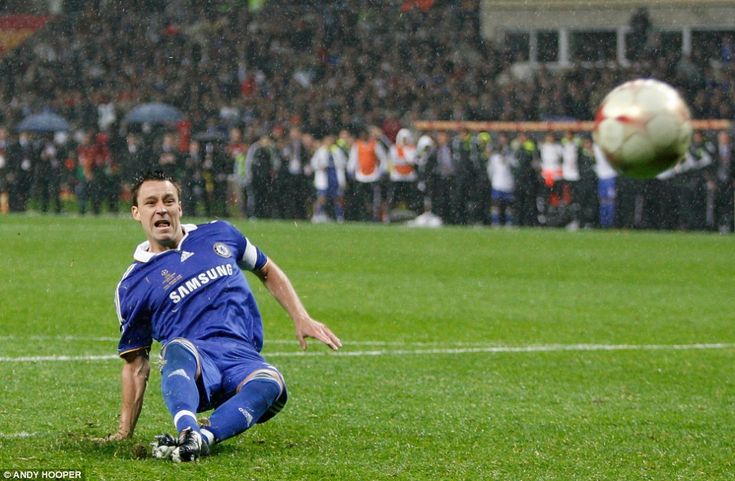
- In the 2008 UEFA Champions League final, Chelsea captain John Terry slipped during the penalty shootout and missed what could have been the winning kick. Chelsea eventually lost to Manchester United, and the moment became one of the most heartbreaking scenes in football history.
Quote
- The system is not broken. It was built this way.