Inconsistent Definitions — The Invisible Trap of Debates
In modern public discourse, conflicts of opinion seem to be everywhere. From online controversies to academic debates and everyday disagreements, people often engage in fierce arguments without reaching any consensus. On the surface, this appears to be a clash of differing viewpoints. But upon closer examination, we find that many seemingly opposing arguments stem not from true ideological divergence, but from inconsistent definitions of key concepts.
I. Definition: The Foundation of Thought
In all logical reasoning, definitions are the most fundamental premises. If a concept is not clearly defined, its referent becomes ambiguous during argumentation, ultimately undermining the entire reasoning structure. Aristotle pointed out in the Organon that scientific discussion should begin with establishing definitions. If we cannot even agree on what we are talking about, how can we agree or disagree meaningfully?
For example, when people debate “the purpose of education,” one party might understand education as “the transmission of knowledge,” while another views it as “the cultivation of character.” This divergence leads to conflict over whether education should focus on academic performance or moral development. However, if both parties recognize their differing definitions of “education” from the outset, much of the disagreement would dissipate or at least shift to a more concrete level.
II. Inconsistent Definitions Lead to Logical Misalignment
Inconsistent definitions directly sabotage valid reasoning. In a chain of logic, if the concept A in the premise is not the same as concept A’ in the conclusion (despite using the same term), the argument commits an equivocation fallacy—one of the most common and subtle logical errors.
For instance, suppose one person claims, “Freedom is the foundation of society, so the government should not restrict anyone’s actions.” Another replies, “If freedom means anarchy, it will only lead to chaos.” The problem is that both are using the term “freedom,” but referring to different concepts: the first might mean “freedom from arbitrary interference,” while the second interprets it as “lack of all constraints.” Without clarifying the definitions, such a debate will never converge.
III. Semantic Drift in Social Contexts
In social contexts, the meaning of terms often drifts depending on group identity, ideology, or situational context. For example, “fairness” to a free-market liberal may mean “equal rules without interfering with outcomes,” whereas to a social justice advocate, it might mean “reasonable outcomes with compensatory opportunity.” Both sides are speaking of “fairness,” but their interpretations are fundamentally at odds.
This semantic drift causes public discourse to devolve into echo chambers. Each side believes it occupies the moral high ground, while in fact, they are attaching entirely different semantic frameworks to the same word. As a result, in the absence of semantic clarification, public discussions often spiral into polarization and the retreat of rationality.
IV. Strategies to Avoid Definition Confusion
To avoid invalid arguments caused by definitional inconsistency, the following strategies are crucial:
- Define key terms explicitly: At the outset of a discussion, state clearly how you understand core terms—especially those prone to contextual ambiguity (such as freedom, fairness, justice, rights, etc.).
- Clarify the other party’s usage: Before refuting, ensure you understand how the other party is using a term, to avoid talking past each other.
- Use operational definitions: In practical or technical discussions, try to concretize abstract terms into measurable, actionable criteria to reduce ambiguity.
- Acknowledge multiplicity of meanings: For complex terms that resist unified definitions, admit their polysemy and specify their scope in conversation to build consensus rather than descend into semantic quibbles.
V. Conclusion: Logical Clarity Begins with Linguistic Clarity
Debate itself is not dangerous—what’s dangerous is wasting cognitive resources in logically incoherent discussions. Truly rational discourse is not about aggressive rebuttals, but about collaborative construction based on clear definitions and valid logic. In an era of information overload and overwhelming opinions, perhaps the most essential step toward meaningful communication and deep reasoning is to return to the starting point of language—to clarify the very words we use.
Picture
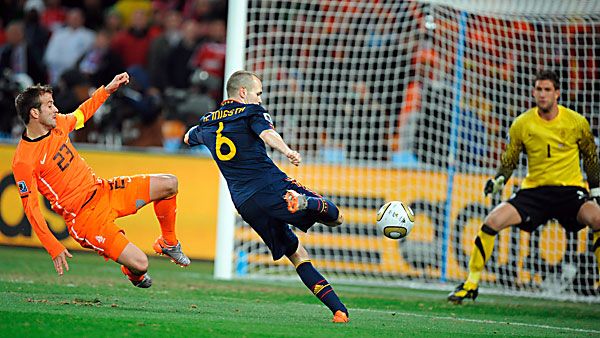
- In the 2010 FIFA World Cup Final in South Africa, Spanish midfielder Andrés Iniesta scored the winning goal in the 116th minute of extra time, securing a 1-0 victory over the Netherlands and delivering Spain’s first-ever World Cup title.
Quote
- Most disagreements are not about beliefs, but about the meanings of words.