Faith, Logic, and the Human Condition
Religion has always been humanity’s attempt to reconcile the unknown with the unbearable. Yet in its long history, what we often see is not wisdom, but a patchwork of dogmas—rigid rules stitched together under the banner of “truth.” When one looks closer, many of these doctrines resemble little more than arbitrary “arrangements of belief,” a grand combinatorial game in which each culture and era selects its own preferred permutation.
Take, for instance, the Catholic demand that priests remain celibate. On the surface, it claims to be a noble sacrifice, a spiritual devotion beyond earthly desire. But in essence, it is a denial of human nature. Sexuality, family, intimacy—these are not trivial distractions; they are part of what makes us fully human. Forcing clergy to live as if they were statues of marble, untouched by desire, produces not saints but distortions. History is littered with the consequences: hypocrisy, secret scandals, and the collapse of credibility. It is less “holiness” than a bureaucratic fantasy, as if human beings could be administratively managed into angels.
And yet, the contradiction runs deeper. If everyone were to obey such rules—if all faithful men and women renounced marriage and childbearing—then religion itself would vanish in a single generation. A community that prohibits reproduction is a community destined for extinction. In other words, the very survival of the faith depends on most believers not following its strictest ideals. The structure endures only because the masses live in ordinary, “sinful” humanity—marrying, raising children, and thus producing the next generation of worshippers. The faith lives parasitically on the disobedience of its followers.
Of course, Catholicism is hardly unique. Many religions thrive on this same paradox: preaching values impossible to live by, then glorifying the guilt and repentance that follow. By this logic, the religion does not cure the disease—it manufactures it, and then sells itself as the only medicine.
This does not mean that religion is entirely useless. Its stories, symbols, and rituals can provide meaning, comfort, and community. But we must strip away the illusion that any single doctrine holds “universal truth.” In reality, what we call “faith” is simply one configuration of human values among many. For some, it offers order; for others, suffocation.
A wiser approach is to recognize religion as a cultural toolkit: a set of symbols through which people negotiate mortality, morality, and belonging. But the danger lies in mistaking the tool for the truth, the symbol for reality. Once that happens, reason is abandoned, and the very thing meant to serve humanity begins to demand that humanity serve it.
In the end, no divine law can override human nature. What survives across cultures and centuries are not the dogmas that defy logic, but the values that harmonize with our shared humanity: compassion, justice, dignity, and love. Religions that embrace these endure; those that wage war against human essence collapse under their own contradictions.
Perhaps, then, the task for the modern age is not to abandon faith, but to see it clearly: not as a sacred command from above, but as an earthly experiment in meaning-making. And like all experiments, it is judged not by its promises, but by its results.
Picture
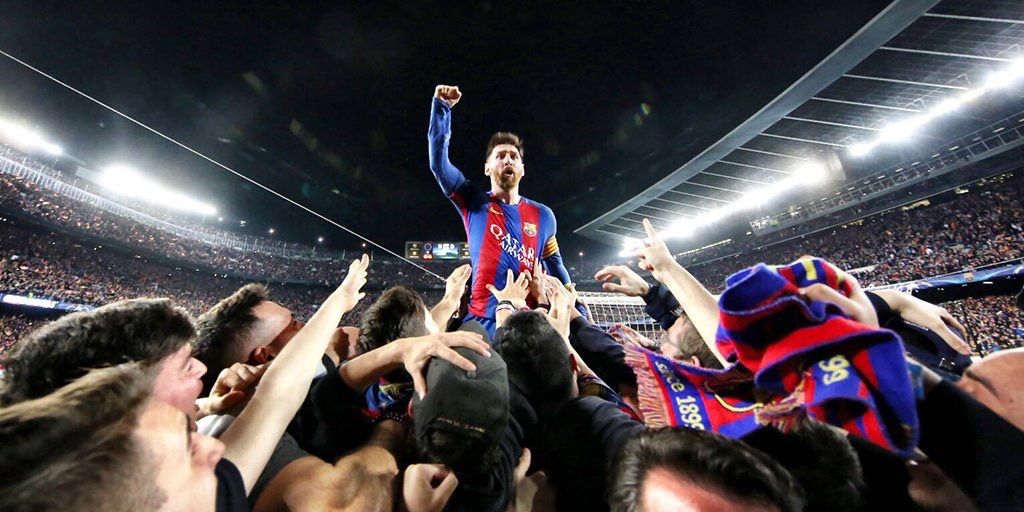
- On March 8, 2017, Barcelona overturned a 4–0 first-leg deficit by beating Paris Saint-Germain 6–1 at home in the Champions League Round of 16, and after the match Messi stood on the advertising board with his fist raised in celebration, creating an iconic Champions League moment.
Quote
- The price of freedom is eternal vigilance.